A “letter writer”
long before the internet, I penned and snailed hand written letters in another
lifetime. I come from generations of inveterate letter writers. That shapes my
earliest writing memories. Learning languages, I would start writing
letters in the new language as soon as I had a handful of words to rub
together. I still am one: same genre, different medium.
Showing posts with label academic writing. Show all posts
Showing posts with label academic writing. Show all posts
Sunday, March 24, 2013
I am an old fashioned letter writer
…yet another MOOC…this one about writing, so I'm putting CWL back in harness to post assignments and reflections. The course is English Composition I: Achieving Expertise, from Duke and on Coursera. It may seem like an odd choice for someone who has taught FY comp: since I have already blogged recommending it to my ESL self-paced study group and on Facebook to local GED students (albeit both with qualifications), I should check it out personally ~ and definitely before recommending it further or adding it to my GED and Independent Learning pages on Scoop.it.
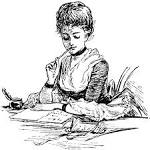 The first writing activity, "I am a Writer," is a "brief essay (~300 words) in which you introduce yourself as a writer to your classmates and instructor. How would you describe yourself as a writer? What are some of your most memorable experiences with writing? Please draw on your experiences with writing and refer directly to some of these as you introduce yourself as a writer. After you have written and posted your essay, please read and respond to two or three of your classmates' postings." Mine (also here on the course Forum) follows:


Thursday, March 22, 2012
Digital Student Writing (Tags #change11 #potcert11 #evomlit)
Upfront disclaimer and confession: this post has nothing to do with current or even recent lesson topics in either Change 11 or Program for Online Teaching. Aha, serendipity alert: inadvertently, I seem to be in sync with the POT Wk 20 topic, instruction design.

Whatever, Digital Student Writing and the perennial problem of getting students to write are germane and central both to the declared focus of this blog and online or computer assisted learning (whatever the current nomenclature flava is). Moocxtination (just made that up, more or less a mashup of MOOC + destination) is less clear, especially without a map or well beaten path to follow. For now, I'm relating it online writing and study groups (e.g. in areas such as GED, ESL, college prep, continuing education, DIY PD, etc. that I have perhaps futile hopes of adapting MOOC model to)
Taking where learners write from the most and are more comfortable writing strikes me as a logical starting point. It's like planning a drainage systen: first see where the water wants to go (or not) and then design accordingly.
Revisualizing Composition: Mapping the Writing Lives of First-Year College Students :: WIDE Research Center, Michigan State University
This white paper reports initial findings from a Writing in Digital Environments (WIDE) Research Center study entitled Revisualizing Composition: Mapping the Writing Lives of First-Year College Students. These initial findings are drawn from a survey of students enrolled in writing classes at a sample of US postsecondary institutions.
Taking where learners write from the most and are more comfortable writing strikes me as a logical starting point. It's like planning a drainage systen: first see where the water wants to go (or not) and then design accordingly.
Revisualizing Composition: Mapping the Writing Lives of First-Year College Students :: WIDE Research Center, Michigan State University
This white paper reports initial findings from a Writing in Digital Environments (WIDE) Research Center study entitled Revisualizing Composition: Mapping the Writing Lives of First-Year College Students. These initial findings are drawn from a survey of students enrolled in writing classes at a sample of US postsecondary institutions.
Tuesday, February 23, 2010
Rules for writing by
These rules are from professional writers, mostly writers of fiction. How do they apply to everyday writing ~ personal, academic, workplace ~ what can you take home from them and put to work in your own writing: Which ones are unrealistic and furthermore reflect an elitist attitude setting the writing of "real writers" apart from the rest of us? Think about it as you read Your rules for writing via Culture | guardian.co.uk by Michelle Pauli on 2/23/10.
 Saturday's selection of expert advice on how to write fiction has generated a lot of interest. But we'd like to know your maxims, too
I really enjoyed Saturday Review's Ten rules for writing fiction feature and, judging by the stats for page hits and the buzz about it on Twitter and other sites, so did many others.
While Jonathan Franzen's point that "It's doubtful that anyone with an internet connection at his workplace is writing good fiction" certainly hit where it hurts, I was struck by how many of the writers emphasised the point that, if you want to write then – to paraphrase – "just bloody write".
As Anne Enright says, "The way to write a book is to actually write a book. A pen is useful, typing is also good. Keep putting words on the page." Neil Gaiman suggests, "1 Write. 2 Put one word after another. Find the right word, put it down." PD James urges [oops, that's one of Elmore Leonard's rules broken] "Don't just plan to write – write. It is only by writing, not dreaming about it, that we develop our own style", while AL Kennedy says: "Write. No amount of self-inflicted misery, altered states, black pullovers or being publicly obnoxious will ever add up to your being a writer. Writers write. On you go."
It comes down to discipline, says Jeanette Winterson: "Turn up for work. Discipline allows creative freedom. No discipline equals no freedom".
I disagreed with very few of the rules, however odd; I'm sure that if any children read the rules they will find Zadie Smith's first rule: "When still a child, make sure you read a lot of books. Spend more time doing this than anything else" helpful. Adults, I'm not so sure. I have to confess to being baffled by Andrew Motion's rule number 9: "Write for tomorrow, not for today". What does that mean?
Except for the "no excuses, just get on with it" rule which simply cannot be argued with, perhaps Michael Moorcock has the last word on rules for writing with "Ignore all proffered rules and create your own, suitable for what you want to say".
For me, and I didn't see this one on anyone's list (perhaps because it applies less to the, frankly terrifying, world of fiction writing than to non-fiction or journalism) is to break it down. It's not a daunting 1,500-word piece, it's a (slightly) less daunting six sections of 250 words; it's a 100-word intro and then four key points of 350 words each. Or, on really bad days, it's a 30-word quote followed by 10 (hopefully) original linking words followed by another 30 word quote followed by ...
We want to know what your own rules, "suitable for what you want to say" are. Claire Armitstead will be discussing the rules for writing with the novelist Toby Litt in this week's Guardian books podcast. Litt, who was named one of Granta's 20 "Best of Young British Novelists" in 2003, studied creative writing at the University of East Anglia where he was taught by Malcolm Bradbury, and now teaches the MA in creative writing at Birkbeck College. As well as considering the rules in the feature, Claire and Toby want to hear your reaction to the rules and especially:
Which did you find particularly helpful?
Which did you find irrelevant?
What are your own rules for writing?
Don't forget – a pen is useful, so's a pencil, but typing is also good. Over to you.
I really enjoyed Saturday Review's Ten rules for writing fiction feature and, judging by the stats for page hits and the buzz about it on Twitter and other sites, so did many others.
While Jonathan Franzen's point that "It's doubtful that anyone with an internet connection at his workplace is writing good fiction" certainly hit where it hurts, I was struck by how many of the writers emphasised the point that, if you want to write then – to paraphrase – "just bloody write".
As Anne Enright says, "The way to write a book is to actually write a book. A pen is useful, typing is also good. Keep putting words on the page." Neil Gaiman suggests, "1 Write. 2 Put one word after another. Find the right word, put it down." PD James urges [oops, that's one of Elmore Leonard's rules broken] "Don't just plan to write – write. It is only by writing, not dreaming about it, that we develop our own style", while AL Kennedy says: "Write. No amount of self-inflicted misery, altered states, black pullovers or being publicly obnoxious will ever add up to your being a writer. Writers write. On you go."
It comes down to discipline, says Jeanette Winterson: "Turn up for work. Discipline allows creative freedom. No discipline equals no freedom".
I disagreed with very few of the rules, however odd; I'm sure that if any children read the rules they will find Zadie Smith's first rule: "When still a child, make sure you read a lot of books. Spend more time doing this than anything else" helpful. Adults, I'm not so sure. I have to confess to being baffled by Andrew Motion's rule number 9: "Write for tomorrow, not for today". What does that mean?
Except for the "no excuses, just get on with it" rule which simply cannot be argued with, perhaps Michael Moorcock has the last word on rules for writing with "Ignore all proffered rules and create your own, suitable for what you want to say".
For me, and I didn't see this one on anyone's list (perhaps because it applies less to the, frankly terrifying, world of fiction writing than to non-fiction or journalism) is to break it down. It's not a daunting 1,500-word piece, it's a (slightly) less daunting six sections of 250 words; it's a 100-word intro and then four key points of 350 words each. Or, on really bad days, it's a 30-word quote followed by 10 (hopefully) original linking words followed by another 30 word quote followed by ...
We want to know what your own rules, "suitable for what you want to say" are. Claire Armitstead will be discussing the rules for writing with the novelist Toby Litt in this week's Guardian books podcast. Litt, who was named one of Granta's 20 "Best of Young British Novelists" in 2003, studied creative writing at the University of East Anglia where he was taught by Malcolm Bradbury, and now teaches the MA in creative writing at Birkbeck College. As well as considering the rules in the feature, Claire and Toby want to hear your reaction to the rules and especially:
Which did you find particularly helpful?
Which did you find irrelevant?
What are your own rules for writing?
Don't forget – a pen is useful, so's a pencil, but typing is also good. Over to you.
Friday, December 4, 2009
Can Online Peer Assessment be Trusted?
Review of an article by - L'hadi Bouzidi and Alain Jaillet, a proposed solution to composition's perennial paperwork conundrum
The excessive workload generated by the assessment of exam papers in large classes and the need to give feedback in time often constitute a rather heavy burden for teachers. The online peer assessment can contribute to reduce this workload and, possibly, to improve learning quality by assigning the assessment task to students. However, this raises the question of validity. In order to study this question, we carried out an experiment of online peer assessment in which 242 students, enrolled in 3 different courses, took part. The results show that peer assessment is equivalent to the assessment carried out by the professor in the case of exams requesting simple calculations, some mathematical reasoning, short algorithms, and short texts referring to the exact science field (computer science and electrical engineering).


![Reblog this post [with Zemanta]](https://lh3.googleusercontent.com/blogger_img_proxy/AEn0k_tQf-X5BmxLsZKeT_eARhcMJjQCy46Zl-HmZesPmc2swDbzgGNVcI-5l9jeyLj2vleMU_A4k7779ZmKqsf0hec3OAFY6er8OYJx4jjIBrIlfYx50ZyVjimDmOWay1Y33yIclIuaqEAVfwaGxdcq1Yxy=s0-d)
Can Online Peer Assessment be Trusted? - L’hadi Bouzidi and Alain Jaillet, Educational Technology and Society blogging Online Learning Update by Ray on 12/4/09 via Google Reader
The excessive workload generated by the assessment of exam papers in large classes and the need to give feedback in time often constitute a rather heavy burden for teachers. The online peer assessment can contribute to reduce this workload and, possibly, to improve learning quality by assigning the assessment task to students. However, this raises the question of validity. In order to study this question, we carried out an experiment of online peer assessment in which 242 students, enrolled in 3 different courses, took part. The results show that peer assessment is equivalent to the assessment carried out by the professor in the case of exams requesting simple calculations, some mathematical reasoning, short algorithms, and short texts referring to the exact science field (computer science and electrical engineering).
Tuesday, December 1, 2009
starting a new class: advanced writing
Volunteer teaching for StudyCom is not without its frustrations. The freedom to change teaching topics, experiment with methods and materials, develop new classes ~ in short, teach the way you want, not what or how an administrator tells you ~ offsets those frustrations.
Over the years, I have taught or directed an intermediate class (emphasis on grammar and writing), a reading group, a self paced study group for high beginner to intermediate and, most recently, a beginner class (although one with some intermediate students). This last has morphed into a loose, blog based study/ writing group. Online asynchronous text based (no voice) classes are not well suited to absolute, beginning from scratch beginners unless they are exceptionally motivated.
I let the group lapse ... various reasons, not the least being because I could and it was so informal that doing so was easy. Also, it was time for a change ~ an new course.
Over the years, I have taught or directed an intermediate class (emphasis on grammar and writing), a reading group, a self paced study group for high beginner to intermediate and, most recently, a beginner class (although one with some intermediate students). This last has morphed into a loose, blog based study/ writing group. Online asynchronous text based (no voice) classes are not well suited to absolute, beginning from scratch beginners unless they are exceptionally motivated.
I let the group lapse ... various reasons, not the least being because I could and it was so informal that doing so was easy. Also, it was time for a change ~ an new course.
Subscribe to:
Posts (Atom)
